
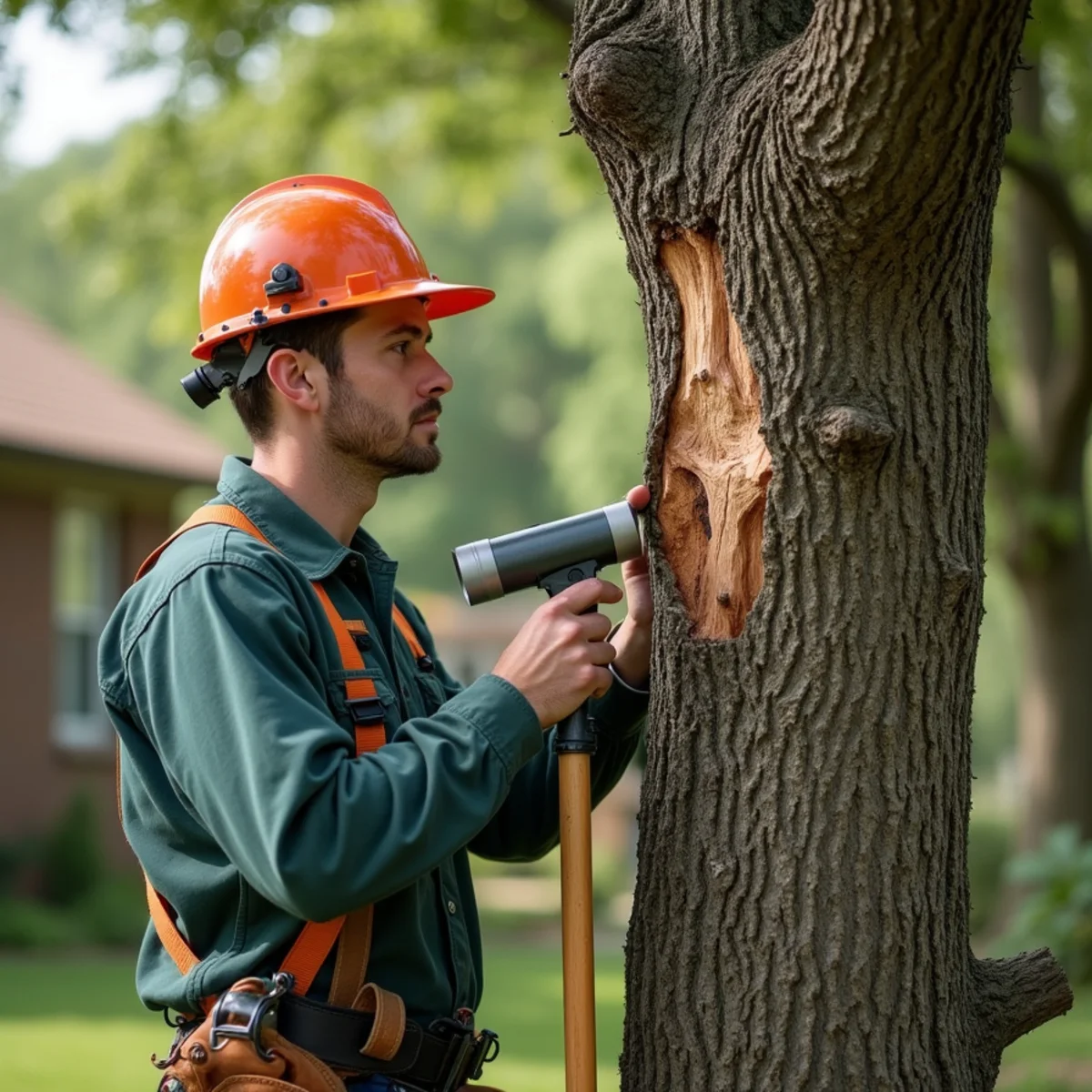
Arborist Tree Health Assessment in Salisbury, NC
Direct Salisbury, NC Solution:
Comprehensive diagnostic evaluations for oak decline, bacterial leaf scorch, root compaction, and structural risks across Rowan County.
Get a Quote for Arborist Tree Health Assessment
Owner Joe will review your tree & schedule an on-site visit
Overview & Arboricultural Standards
Not every troubled tree needs to be removed. Many mature shade trees in Salisbury can be saved, restored, and preserved when diseases, fungal infections, or structural flaws are detected early. Knowing whether a declining tree can be nursed back to health or represents an imminent hazard requires trained diagnostic expertise.
Joe's Tree Care provides thorough on-site tree health evaluations for homeowners and property managers throughout Salisbury and Rowan County. We inspect the entire tree system—from fine twig dieback in the upper crown down to the subterranean root flare.
We check for regional Piedmont tree threats including Sudden Oak Decline, Bacterial Leaf Scorch, Armillaria root rot, hypoxylon canker, and soil compaction. Following our evaluation, you receive an honest, transparent plan: keep and prune, cable and brace, fertilize, or safely remove.
What's Included in Our Arborist Tree Assessment
Itemized deliverables covered in your written estimate
Crown Density & Tip Dieback Inspection
Evaluating annual shoot extension, foliage chlorosis, canopy vigor, and upper crown deadwood (stagheading).
Trunk Acoustic Sounding & Cavity Probing
Detecting hidden internal heartwood rot, hollow spaces, and active bacterial wetwood weeping on trunk stems.
Root Collar Excavation & Flare Examination
Inspecting the buttress flare for girdling roots, soil burial asphyxiation, and Armillaria fungal honey mushrooms.
Piedmont Clay Soil Compaction & Drainage Check
Assessing soil penetrability, root zone drainage restrictions, and drought stress markers in Cecil clay.
Pest & Pathogen Identification
Diagnosing Southern pine beetle pitch tubes, hypoxylon cankers, ambrosia beetles, and bacterial leaf scorch.
Written Tree Health & Risk Prescription
Actionable report detailing therapeutic pruning, dynamic cabling, deep-root feeding, or safe removal recommendations.
When to Request a Tree Health Inspection
- Premature autumn leaf discoloration or leaf drop in the middle of summer.
- Dieback starting at the very tips of upper crown branches (stagheading).
- Sap weeping or black oozing stains on the trunk bark.
- Unusual swellings, burls, or fungal fruiting brackets on the trunk or buttress roots.
- Recent construction or heavy equipment traffic within the tree's drip line causing root compaction.
- Thin, chlorotic (yellowing) foliage indicating nutrient uptake deficiency or root girdling.
Our 4-Point Health Diagnostic Protocol
Crown & Foliage Inspection
We examine leaf color, canopy density, annual shoot extension growth, and insect feeding damage across the upper structure.
Trunk Integrity & Bark Sounding
We inspect bark seams, sound the trunk for internal decay cavities, and identify fungal cankers or insect boring galleries.
Root Collar & Soil Analysis
We examine the root flare for girdling roots, soil compaction, improper mulch volcanoes, and signs of root-rotting fungi.
Written Care or Removal Prescription
You receive a clear, prioritized recommendation: therapeutic pruning, deep-root aeration, dynamic cabling, or safe removal.
Follow-Up Prescription & Seasonal Monitoring Plan
We provide seasonal benchmarks and monitoring schedules to track canopy recovery or catch decline progression early.
Assessment & Treatment Cost Factors
We believe in complete pricing transparency. Because every tree and property has different drop zones, power lines, and trunk diameters, your written quote is based on clear, honest physical factors:
Single Specimen vs. Full Property Survey
Inspecting a single focal oak tree is fast; comprehensive tree inventories for estates or HOAs are quoted on a custom parcel basis.
Estimate Credit Policy
If our assessment indicates that tree removal or major corrective pruning is required, the evaluation fee is credited directly toward your service.
Diagnostic Resistance Micro-Drilling (If Needed)
Advanced internal decay testing using micro-resistance drills is quoted only when saving a historic specimen justifies the test.
Tree Count & Estate Acreage
Single shade tree assessments carry our flat inspection fee, while multi-tree HOA or estate surveys receive volume discounts.
Why Salisbury Homeowners Choose Joe's for Arborist Tree Health Assessment
Our reputation across Rowan County is built on craftsmanship, honest on-site evaluations by owner Joe, and respect for your lawn and landscaping:
20+ Piedmont Experience
Over 15 years navigating Piedmont red clay stability, seasonal ice storms, and mature hardwood rigging.
4.8★ Google Rating (63 Reviews)
Independently verified Rowan County homeowners praising prompt arrival, fair quotes, and rake-clean lawns.
Owner Joe & Climber Tyler On-Site
No subcontracted crews or commission-hungry salesmen. You speak directly with the arborists working your trees.
Lawn Protection Mats Guarantee
We deploy composite turf-saving ground mats to safeguard delicate grass, sprinkler systems, and paver driveways.
Oak Decline & Root System Stresses in Salisbury Historic Districts
Salisbury is famous for its grand, century-old willow oaks, white oaks, and water oaks that grace historic neighborhoods like West Square, Fulton Heights, and the Brooklyn South Square area. However, these mature urban giants face immense physiological stress.
Decades of sidewalk construction, utility trenching, driveway paving, and Piedmont clay soil compaction have severely restricted root expansion and oxygen diffusion. Combined with hotter, drier Carolina summers, mature oaks fall victim to 'Oak Decline'—a syndrome where drought stress invites secondary invaders like hypoxylon canker fungi and two-lined chestnut borers.
Joe's Tree Care provides expert arborist evaluations to preserve these irreplaceable historic shade trees wherever possible. We recommend root flare air-spading, deadwood canopy thinning, and organic root biostimulants to revitalize historic trees, reserving removal strictly for trees with non-correctable structural failure.
Serving Salisbury, Rowan County & Surrounding Piedmont Towns
Joe's Tree Care provides prompt dispatch and scheduled arborist tree health assessment across Rowan County, with rapid response times in Salisbury (HQ), Spencer, China Grove, Granite Quarry, Rockwell, and neighboring communities in Kannapolis and Concord. Whether you need planned preventative maintenance or urgent storm hazard stabilization, our locally based crews are just minutes away.
Frequently Asked Questions About Arborist Tree Health Assessment
Can an oak tree with fungal mushrooms at the base be saved?
Mushrooms or conks growing directly on the trunk flare or buttress roots usually indicate advanced decay of the tree's main structural support roots. In most cases, trees with extensive base conks cannot be saved and pose severe windthrow risks.
What is causing the oak trees to die across Salisbury?
Many mature oaks in the Piedmont are suffering from Oak Decline—a complex caused by prolonged summer droughts, Piedmont red clay soil compaction, root pathogens like Phytophthora, and opportunistic pests like two-lined chestnut borer and hypoxylon canker.
What is a 'mulch volcano' and why is it killing trees?
Piling mulch high against the trunk of a tree (a mulch volcano) traps moisture against the bark, suffocates root flare oxygen exchange, and encourages fungal rot and girdling roots. Mulch should always be kept 3 to 6 inches away from the trunk flare.
What does 'stagheading' mean in an oak tree?
Stagheading refers to dead, bare upper branches protruding above the green canopy like antlers. It is a classic indicator that the tree's root system can no longer pump adequate water and nutrients to the highest extremities, often signaling early-stage oak decline or root severing.
Can root flare aeration help a declining mature oak?
Yes. In the tight red clay soils of Salisbury, using compressed air (air-spading) to loosen compacted soil and expose buried root flares restores oxygen and water uptake without cutting roots, often reversing premature canopy decline.
Helpful Guides & Articles Related to This Service
Schedule Your Free Arborist Tree Health Assessment Estimate Today
Honest pricing, careful limb rigging, and a clean yard promise from Joe's Tree Care.