
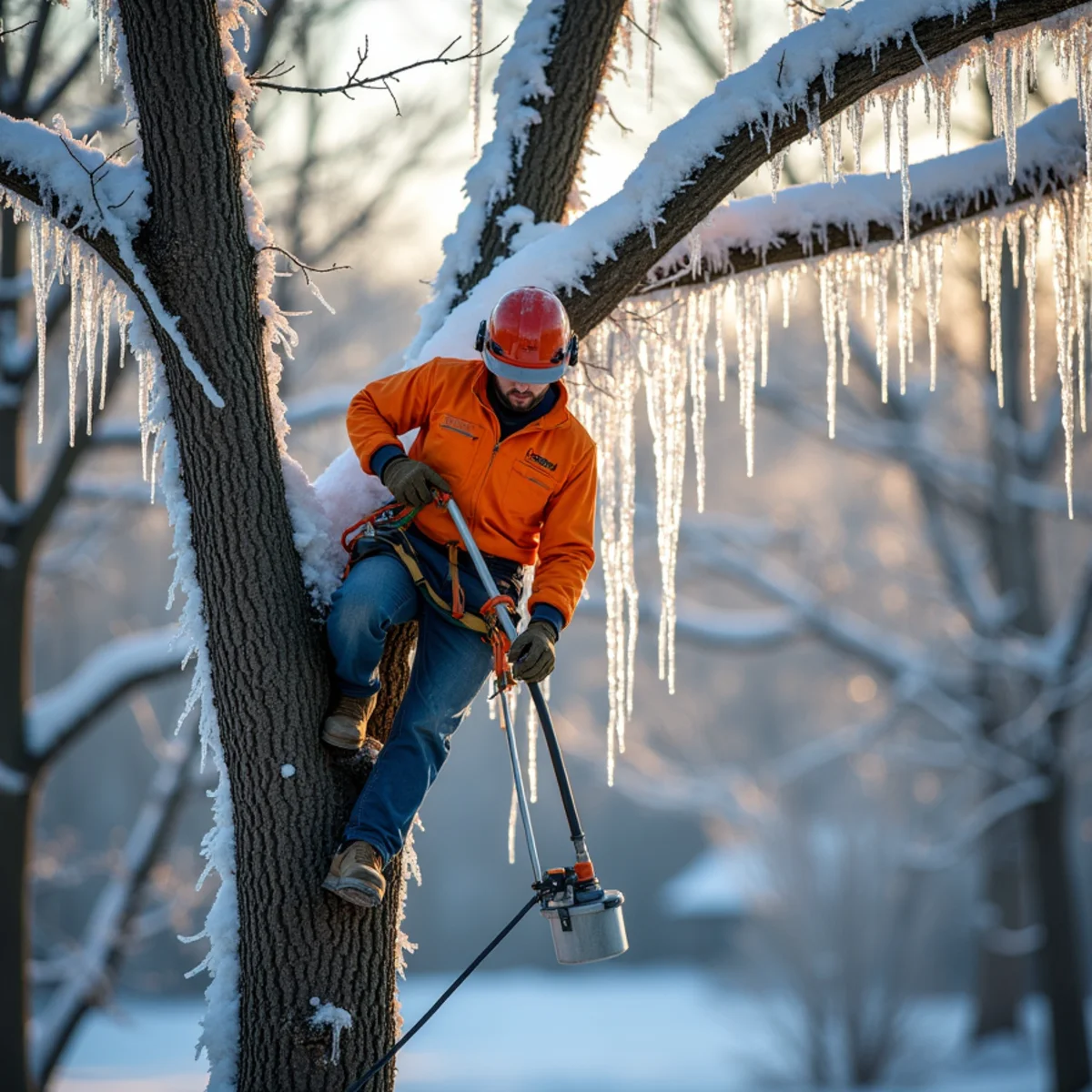
Ice storm tree damage in Rowan County occurs when freezing rain accumulates over 0.25 to 0.75 inches on branches, adding thousands of pounds of static load that snaps pine crowns and splits hardwood trunks. Homeowners should stay at least 35 feet away from sagging limbs and downed wires, avoid cutting spring-loaded branches, and call Joe's Tree Care at (855) 615-0568 for professional hazard removal and restorative crown pruning.
The Anatomy of a Piedmont Freezing Rain Event
The Carolina Piedmont occupies a notorious weather corridor for severe winter glaze ice storms. Cold air damming (CAD) pushes shallow, sub-freezing Arctic air southward along the eastern slope of the Appalachian Mountains, trapping freezing temperatures near the surface while warm, moisture-laden air flows overhead from the Gulf of Mexico and Atlantic Ocean. Rain falls through the warm upper layer and freezes upon contact with tree canopies, power lines, and roads.
While deciduous hardwood trees have shed their leaves in winter, their intricate network of twigs and branches provides massive surface area. A radial ice accumulation of just one-quarter inch adds roughly 30 times the weight of a branch. When ice thickness reaches one-half inch to three-quarters of an inch, a mature 60-foot oak can carry an additional 5,000 to 10,000 pounds of ice load, triggering catastrophic structural limb failure across Rowan County ice storm recovery corridors and for Davidson County property owners.
Piedmont Tree Species Ice Storm Vulnerability Chart
Not all trees react equally to freezing rain. Decades of storm damage observations across Salisbury, China Grove, and Lexington reveal stark differences in wood elasticity and structural architecture:
| Tree Species | Failure Mode Under Ice Load | Vulnerability Level | Recommended Arborist Action |
|---|---|---|---|
| Bradford Pear (Callery) | Trunk splits down center co-dominant unions; complete structural shattering. | Extreme | Complete removal; replace with native flowering dogwood or redbud. |
| Loblolly Pine | Trunk snaps midway up (30-50 ft); root plate heave in saturated wet clay. | Very High | Sectional removal if planted within striking distance of homes. |
| Silver Maple | Brittle, fast-growing limbs shear off at narrow crotch angles. | High | Crown reduction pruning and dynamic cabling of heavy multi-stems. |
| Willow Oak / Water Oak | Upper lateral branch snaps; heavy horizontal limbs split near trunk. | Moderate | End-weight reduction pruning and removal of deadwood. |
| White Oak / Hickory | Strong wood fiber elasticity; minimal limb loss except on deadwood. | Low (Resilient) | Routine health assessments and clearance trimming away from gutters. |
Hidden Canopy Perils: Overhead Widow-Makers & Stored Tension Wood
The days immediately following an ice storm are statistically more hazardous for homeowners than the storm itself. As temperatures rise above freezing, thawing ice detaches in heavy sheets, and fractured branches that were pinned by ice suddenly snap free. Two major physical hazards require extreme caution:
- Overhead 'Widow-Makers' (Hangers): Broken limbs that severed high in the tree canopy but remain snagged in lower branches are known in arboriculture as widow-makers. When wind blows or remaining ice melts, these multi-hundred-pound limbs fall silently with lethal force. Never walk beneath damaged trees until a professional inspects the crown.
- Spring-Poles (Stored Hydraulic Tension): Saplings, lower limbs, and understory branches that are pinned to the ground beneath fallen trees or heavy ice are under immense spring-loaded mechanical tension. If cut incorrectly with a chainsaw, the stored energy releases instantly like a catapult, throwing the saw or violently striking the operator. Professional arborists use special boring plunge cuts and progressive relief cuts to neutralize spring-poles safely.
The 4-Step Ice Storm Recovery Protocol for Homeowners
When recovering from winter storm damage in central North Carolina, follow this systematic arborist protocol:
- Establish a Safety Exclusion Perimeter: Tape off or block access to areas beneath sagging branches, split stems, or trees leaning toward structures or walkways.
- Never Touch Trees Entangled with Wires: If an ice-laden branch touches an electrical wire or pulls down a service drop cable, assume the entire tree is energized. Call Duke Energy and keep family members at least 35 feet away.
- Hire Professional Cleanup Equipment: Clearing storm debris by hand or with consumer equipment takes days of backbreaking labor. Professional storm damage tree cleanup in Salisbury mobilizes heavy-duty commercial wood chippers and mini-skid steers to mulch tons of branches in hours.
- Invest in Restorative Pruning: Surviving trees with torn branch stubs need corrective care. Broken bark creates open entry wounds for wood-boring insects and decay fungi. Our arborists perform clean collar cuts through restorative tree trimming and pruning to facilitate natural callus compartmentalization in spring.
Restorative Pruning vs. Harmful Tree Topping
Following a severe ice storm, uncertified "storm-chasing" contractors often flood neighborhoods offering to "top" damaged trees—hatching off all upper branches down to blunt stubs. Tree topping is catastrophic malpractice. Topping permanently destroys a tree's natural branch architecture, removes photosynthetic food storage, and stimulates a panic response of weakly attached water-sprouts (epicormic shoots). These rapidly growing shoots lack deep structural attachment and are virtually guaranteed to snap off during the very next winter ice event.
Joe's Tree Care practices strict ANSI A300 pruning standards. Rather than butchering storm-damaged trees, our certified team selectively removes broken stems, reduces extended lateral branch weight, and restores a balanced, aerodynamically sound crown that can withstand future Piedmont winter storms.
Step-by-Step Visual Field Guide
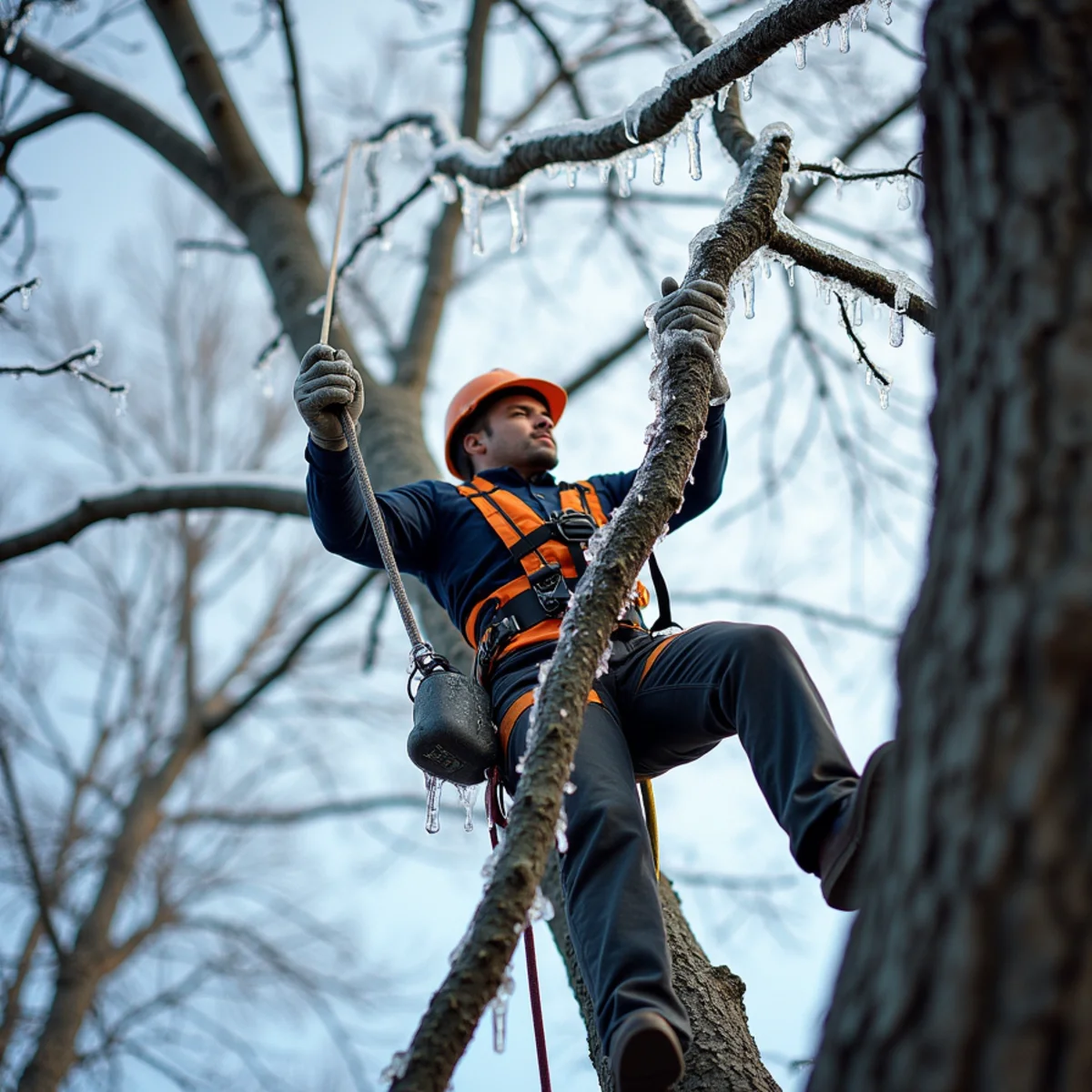
Ice-coated broken tree limb suspended dangerously in canopy
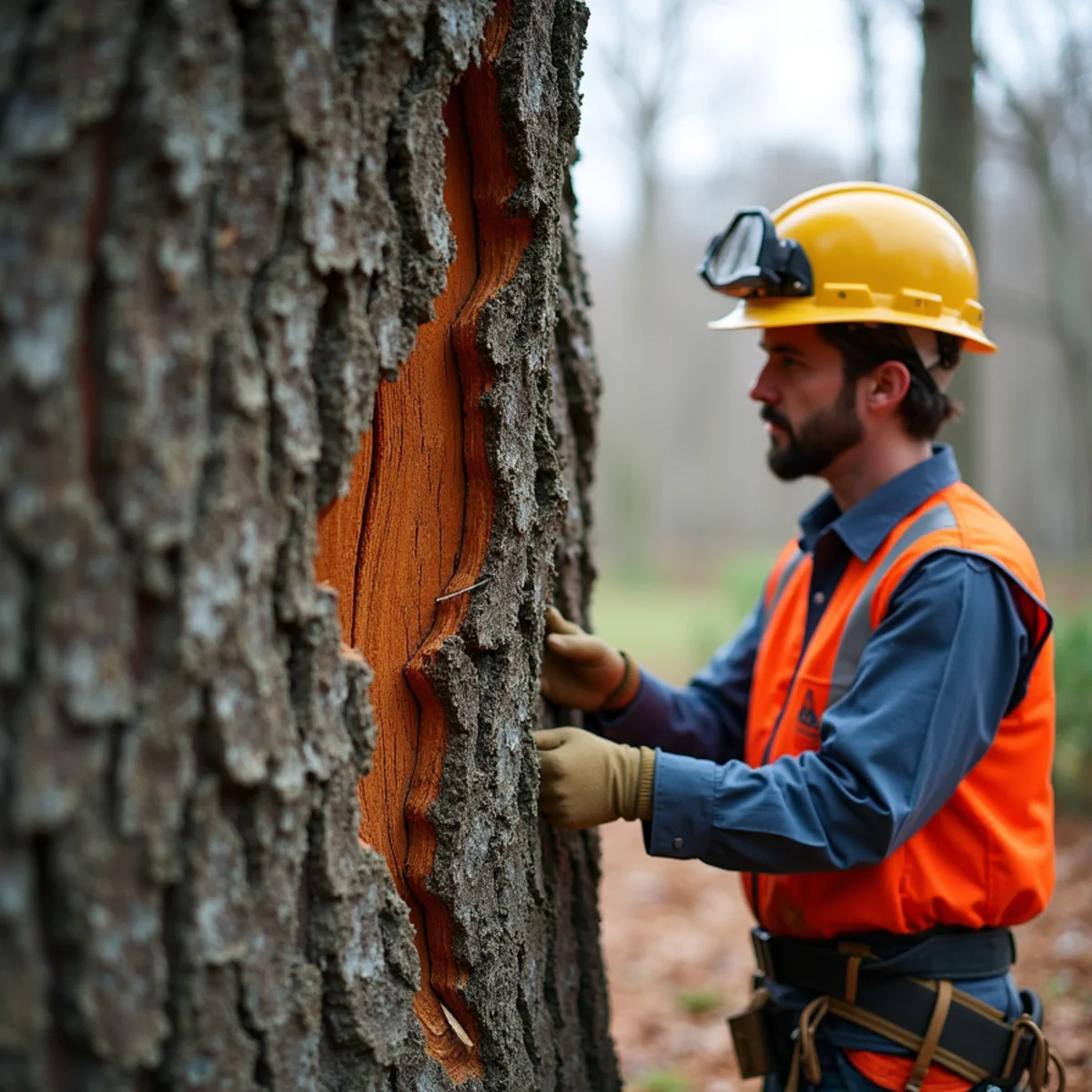
Vertical trunk crack in maple tree caused by heavy winter ice load
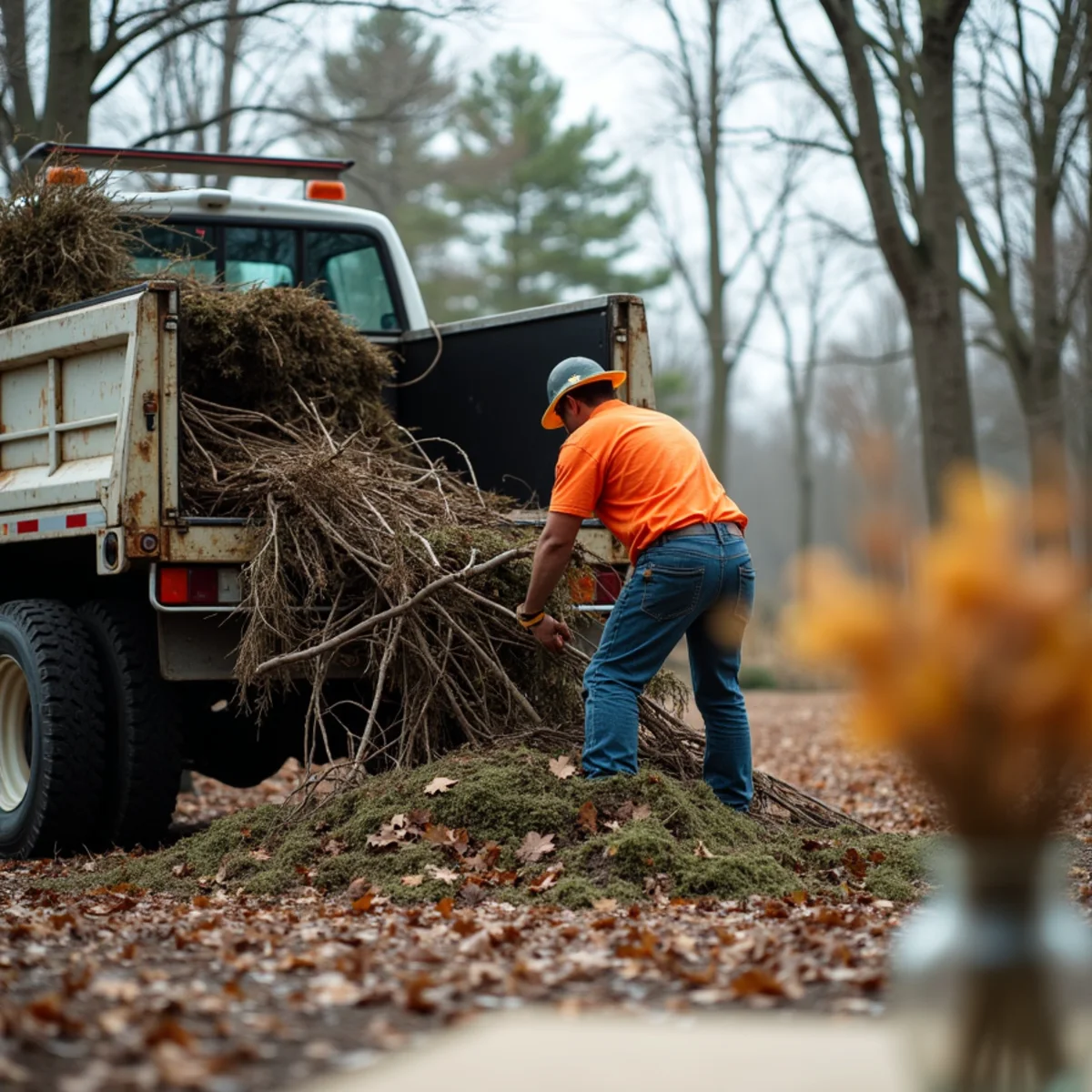
Chipping ice storm downed brush into commercial tree truck
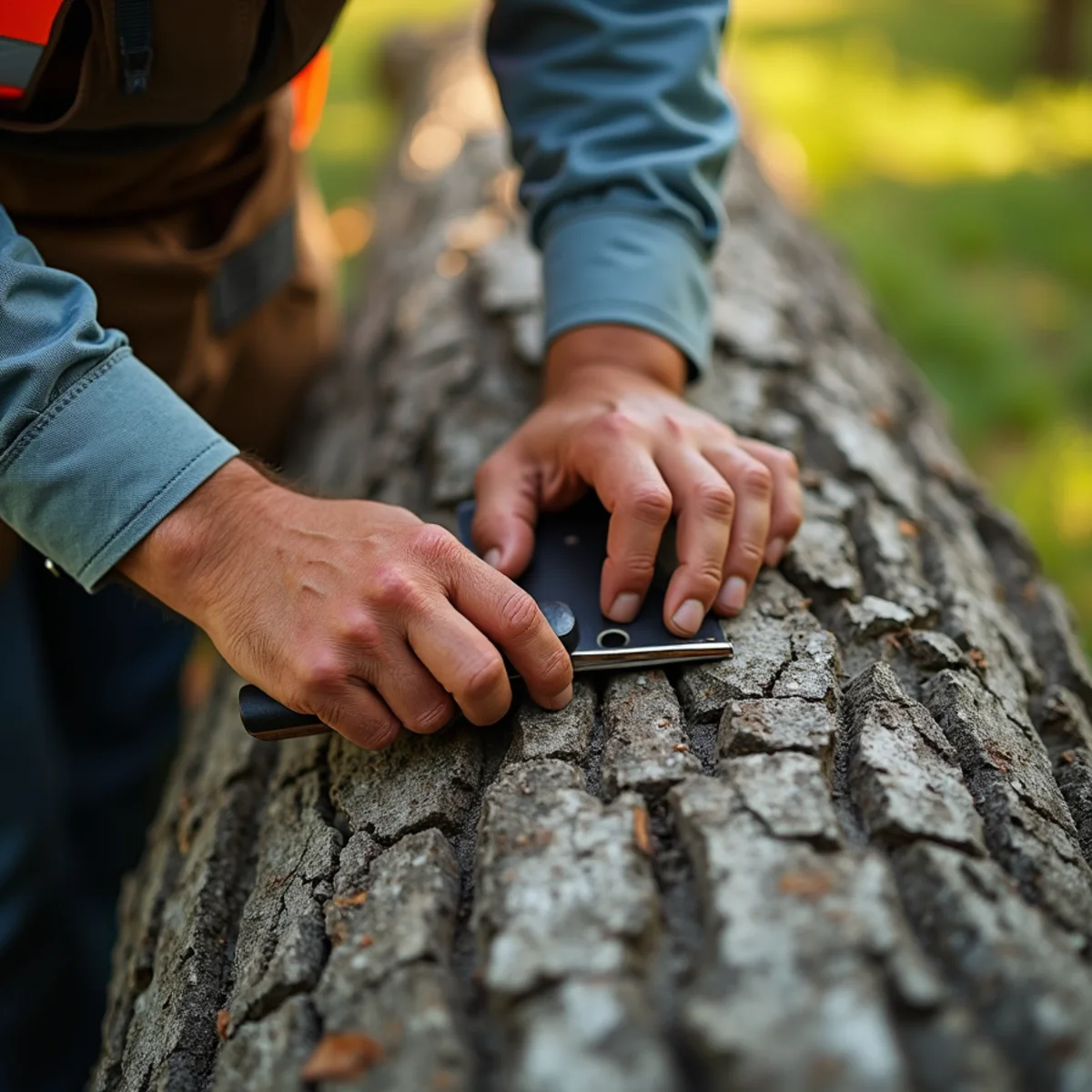
Arborist performing clean collar pruning cut on storm damaged oak
Questions & Answers About This Topic
Can a tree that split during an ice storm be saved?
If the split is fresh and caught early, dynamic steel cabling and through-rod bracing by an arborist can sometimes save a valuable shade tree. However, if the split extends more than a third of the way down the trunk, removal is typically the safest option.
Should I knock or shake ice off my tree branches?
No. Cold, ice-encased wood is extremely brittle. Shaking or beating branches with brooms can cause frozen branches to snap cleanly off, causing more damage to the tree and risking personal injury from falling ice chunks.
Does homeowners insurance cover trees damaged by ice storms in NC?
Insurance covers the cost to remove trees and branches that fall onto covered structures like roofs, garages, or fences. However, trees that fall harmlessly in the yard without hitting a structure typically have strict sub-limits ($500-$1,000) or are excluded.
Why do Bradford pear trees always split in half during Piedmont ice storms?
Bradford pears naturally produce numerous co-dominant trunks with weak 'V-crotches' and embedded bark. They lack a strong central trunk leader. Under heavy ice loading, the leverage forces the stems apart, causing the tree to split down the center.
Joe's Tree Care Field Editorial Team
Published by owner Joe and the arboricultural team at Joe's Tree Care. Serving Salisbury, Spencer, China Grove, and Rowan County with professional tree cutting, crane takedowns, and 24/7 storm damage recovery.