
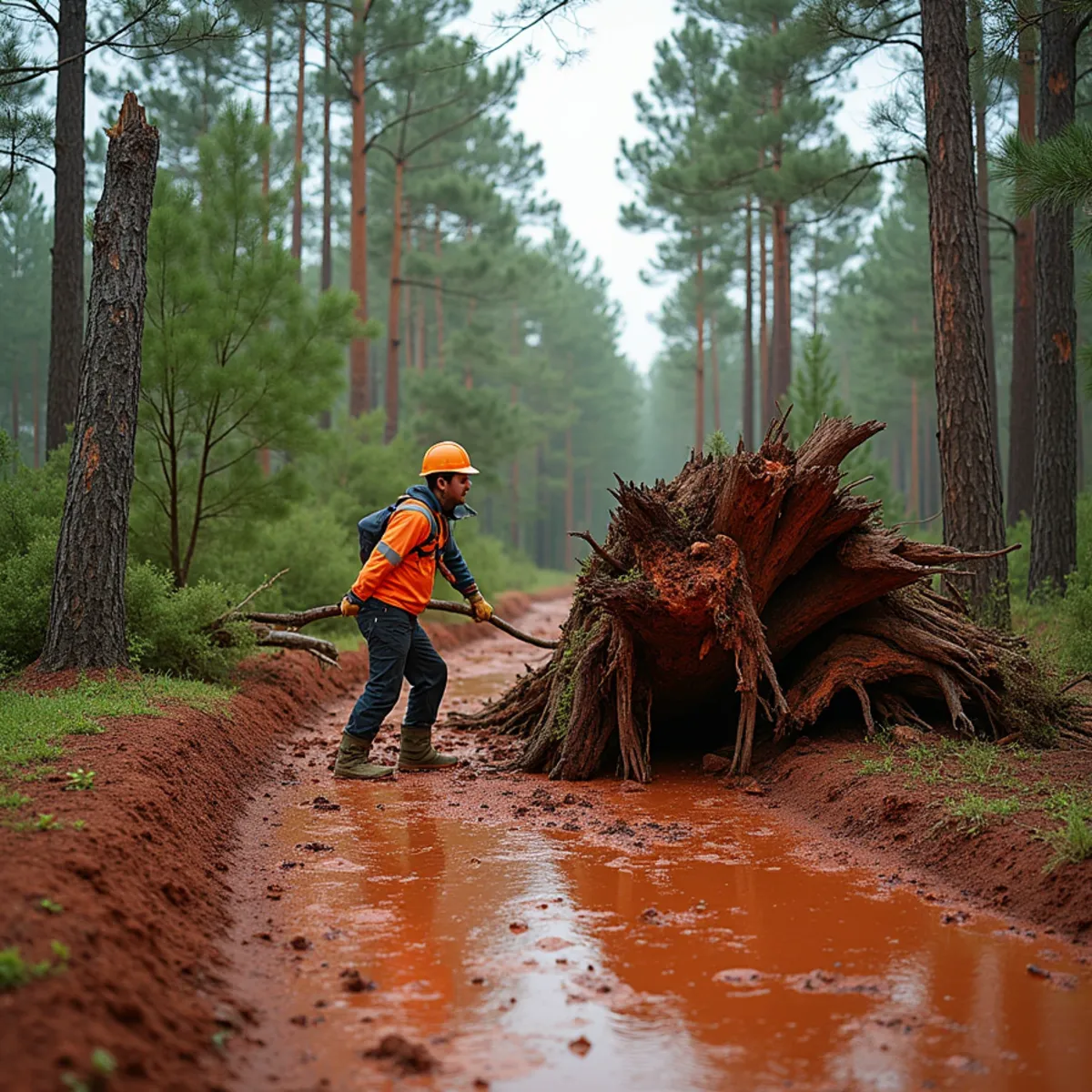
Tropical storm and hurricane remnants cause widespread tree damage in Salisbury, NC, because inland storms drop 4 to 8 inches of rain that liquefies Piedmont Cecil clay soil before 50+ mph wind gusts strike. Towering loblolly pines with shallow root plates act as giant sails and uproot or snap. Homeowners should inspect trees for soil mounding and lean before hurricane season and call Joe's Tree Care at (855) 615-0568 for proactive pine removals.
Why Coastal Storm Remnants Devastate Inland Rowan County Canopies
Many central North Carolina residents mistakenly assume hurricane preparedness is purely a coastal concern. However, historical storm records demonstrate that decaying tropical cyclones—such as Hugo, Florence, Michael, and tropical systems pushing inland from the Carolina coast—frequently inflict worse residential tree damage in the Piedmont than on the coast itself.
The devastation is caused by a dangerous two-phase weather mechanism: First, tropical feeder bands drop 5 to 10 inches of torrential rain over 24 to 36 hours. Second, as the cyclone core passes, sustained gale-force winds and sudden 60+ mph downbursts strike saturated soil. Trees that withstood dry winter gales topple easily once their root systems lose soil friction in soaked red clay.
The Biomechanics of Loblolly Pine Windthrow in Piedmont Clay
Loblolly pine (Pinus taeda) is the dominant conifer across Salisbury, China Grove, and Kannapolis. While fast-growing and majestic, loblolly pines represent the highest percentage of residential storm damage calls for tree services across Rowan County due to three biological factors:
- Shallow Root Plates in Dense Clay: In undisturbed native forests, pines develop taproots. However, in suburban Piedmont yards where heavy grading and dense Cecil clay hardpan restrict downward root penetration, pines develop shallow, horizontal root mats within the top 18 to 24 inches of soil. When rain saturates clay, the soil loses shear strength, and the entire root plate pulls up like a carpet hinge.
- Evergreen Canopy as a Giant Wind Sail: Deciduous hardwoods shed leaves or allow wind to whistle through open branch structures. Loblolly pines carry millions of dense evergreen needles year-round. A 90-foot pine crown creates hundreds of square feet of aerodynamic drag, transferring enormous torque down the trunk to the compromised root base.
- Brittle Core Wood & Stem Snapping: Under extreme torsional wind loads, if the root plate holds firm in the soil, the upper stem flexes until the internal cellulose fibers reach their tensile limit. The trunk snaps violently 20 to 40 feet off the ground, sending the multi-ton top crashing into roofs or power lines.
Wind Velocity & Expected Canopy Failure Modes
Understanding how different wind velocities impact regional trees helps homeowners assess risk levels during incoming tropical systems:
| Wind Speed (Gusts) | Soil Condition | Expected Failure Mode | High-Risk Tree Species |
|---|---|---|---|
| 35 – 45 mph | Dry to Damp | Deadwood shedding; brittle twigs and secondary lateral branches snap. | Dying pines, dead oak limbs, silver maples. |
| 45 – 60 mph | Moderately Wet | Large limb fractures at weak V-crotches; root plate uplift on compromised trees. | Bradford pear, water oak, shallow pines. |
| 60 – 75+ mph | Fully Saturated Clay | Catastrophic whole-tree windthrow; mid-trunk stem snaps on mature pines. | Towering loblolly pines, mature red oaks, sweetgums. |
| 75+ mph (Hurricane Force) | Flooded Ground | Widespread canopy leveling; healthy mature trees uprooted across wide swaths. | All mature species within open wind exposure zones. |
Warning Signs Your Pine Trees Are at Imminent Risk of Failure
Homeowners in Salisbury and those seeking Kannapolis tree service should inspect their tree canopy well before hurricane season peaks in August, September, and October. Watch for these red flags:
- Mounded Soil or Exposed Root Plates: If the ground on the windward side of a tall pine is lifting, mounding, or cracking, the root plate has begun failing. This is an immediate emergency.
- Lean Toward Dwellings or Driveways: A pine tree with a noticeable lean—especially one that has developed or increased recently—has lost root anchor integrity.
- Dead Needles or Southern Pine Beetle Pitch Tubes: Pines killed by pine bark beetles lose wood elasticity within months. Dead standing pines will not survive tropical storm winds.
- Proximity to Bedrooms & Living Spaces: A 90-foot pine planted 20 feet from your home's foundation is in the direct strike zone. If the tree fails, structural penetration is guaranteed.
Proactive Pine Mitigation: Crown Thinning vs. Sectional Removal
Can tall pines near houses be safely trimmed to reduce wind drag? While light end-weight pruning can reduce wind resistance on hardwoods, you cannot prune a pine tree to make it storm-safe if it is already leaning or planted too close to a house. Pines cannot have their central tops cut without inducing severe decay and eventual death.
If you have tall loblolly pines planted within striking distance of your home, the only permanent safety solution is proactive tall loblolly pine tree removal. Our certified climbers and crane operators systematically dismantle tall pines section by section, lowering heavy log rounds under complete control. Removing high-risk pines ahead of time eliminates the danger of middle-of-the-night roof crashes and prevents the need for emergency dispatch during storm recovery when county-wide roads are blocked. If storm winds have already compromised a tree, Joe's Tree Care provides prompt emergency tree removal dispatch throughout Rowan County.
Questions & Answers About This Topic
How far away from my house should a 70-foot pine tree be?
Ideally, tall pines should be located at a distance greater than their total mature height from any permanent dwelling. A 70-foot pine should be planted at least 70 to 80 feet away to eliminate structural strike risk if it fails.
Can pruning or thinning a pine tree prevent it from falling in a hurricane?
Light canopy thinning can slightly reduce wind drag, but it cannot compensate for shallow root systems in waterlogged clay or structural trunk lean. If a tall pine is within striking distance of a home, removal is often the safest long-term choice.
Why do trees fall after the rain stops when winds pick up?
The heaviest rainfall occurs during the storm's front edge, completely soaking and loosening the red clay soil around the roots. When winds shift and peak on the back side of the storm system, the loose mud cannot provide mechanical resistance, causing delayed uprooting.
Does homeowners insurance pay to remove a pine tree that is leaning after a tropical storm?
Typically, homeowners insurance only covers tree removal if the tree has physically fallen and damaged a covered structure. However, if a tree is actively uprooting and leaning on a roofline or service line, emergency mitigation coverage may apply. We provide full documentation for adjusters.
Joe's Tree Care Field Editorial Team
Published by owner Joe and the arboricultural team at Joe's Tree Care. Serving Salisbury, Spencer, China Grove, and Rowan County with professional tree cutting, crane takedowns, and 24/7 storm damage recovery.